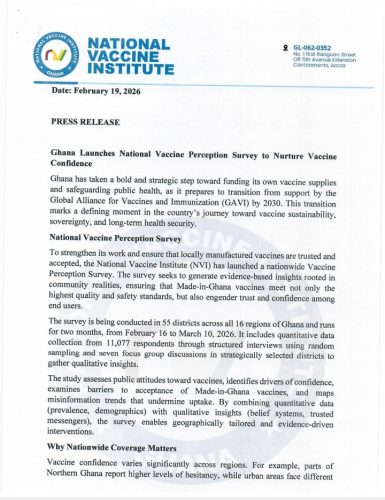


The National Vaccine Institute (NVI) has officially launched a nationwide Vaccine Perception Survey aimed at strengthening public confidence in locally manufactured vaccines, as Ghana prepares to transition from support by the Global Alliance for Vaccines and Immunization (GAVI) by 2030.
In a statement issued on February 19, 2026, the Institute described the survey as a strategic initiative designed to ensure vaccine sustainability, national health security, and long-term vaccine sovereignty. The survey, which began on February 16 and will run until March 10, 2026, is being conducted in 55 districts across all 16 regions of the country.
Through structured interviews, the survey will collect quantitative data from 11,077 respondents using random sampling techniques. In addition, seven focus group discussions will be held in selected districts to gain qualitative insights into public perceptions and concerns regarding vaccines.
The NVI explained that the study seeks to assess public attitudes toward vaccines, identify the key drivers of vaccine confidence, examine barriers to accepting Made-in-Ghana vaccines, and monitor misinformation trends that could hinder vaccine uptake.
According to the Institute, vaccine confidence is not uniform across the country. While certain parts of northern Ghana report relatively higher levels of hesitancy, some urban centres are contending with unique misinformation dynamics that differ from those in rural communities.
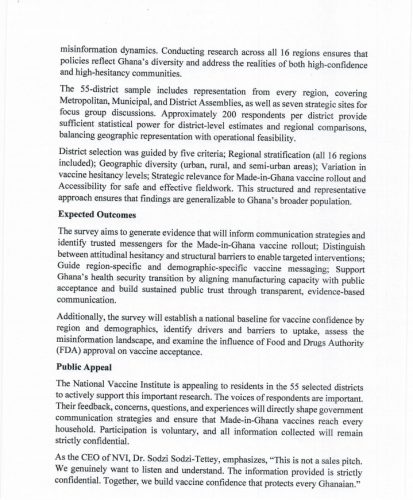
To ensure national representativeness, the selected districts include metropolitan, municipal, and district assemblies. Approximately 200 respondents are being interviewed per district to allow meaningful district-level and regional comparisons. The districts were chosen based on geographic diversity, varying levels of vaccine hesitancy, strategic importance to the rollout of locally produced vaccines, and accessibility for effective fieldwork.
Chief Executive Officer of the NVI, Dr. Sodzi Sodzi-Tettey, emphasized that the initiative is rooted in community engagement and evidence-based planning rather than persuasion.
“This is not a sales pitch. We genuinely want to listen and understand. The information provided is strictly confidential. Together, we build vaccine confidence that protects every Ghanaian,” he stated.
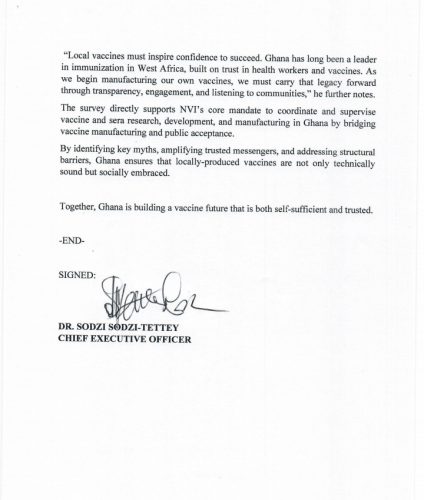
Dr. Sodzi-Tettey also highlighted Ghana’s longstanding reputation as a leader in immunization within West Africa, stressing the importance of safeguarding this legacy as the country advances into domestic vaccine manufacturing.
The NVI further explained that findings from the survey will inform geographically tailored communication strategies to support the rollout of Ghana-made vaccines. The data will also help distinguish between attitudinal hesitancy and structural barriers, enabling health authorities to design targeted, effective interventions.
Additionally, the study is expected to establish a national baseline for vaccine confidence across regions and demographic groups, and assess the influence of Food and Drugs Authority (FDA) Ghana approval on public willingness to accept vaccines.
The Institute has urged residents in the selected districts to cooperate with field teams, assuring that participation is voluntary and that all responses will remain confidential.
By bridging vaccine manufacturing with public trust, the NVI believes Ghana can ensure that locally produced vaccines are not only scientifically sound but also widely trusted and embraced by the population, reinforcing national health security as the country transitions from GAVI support.