
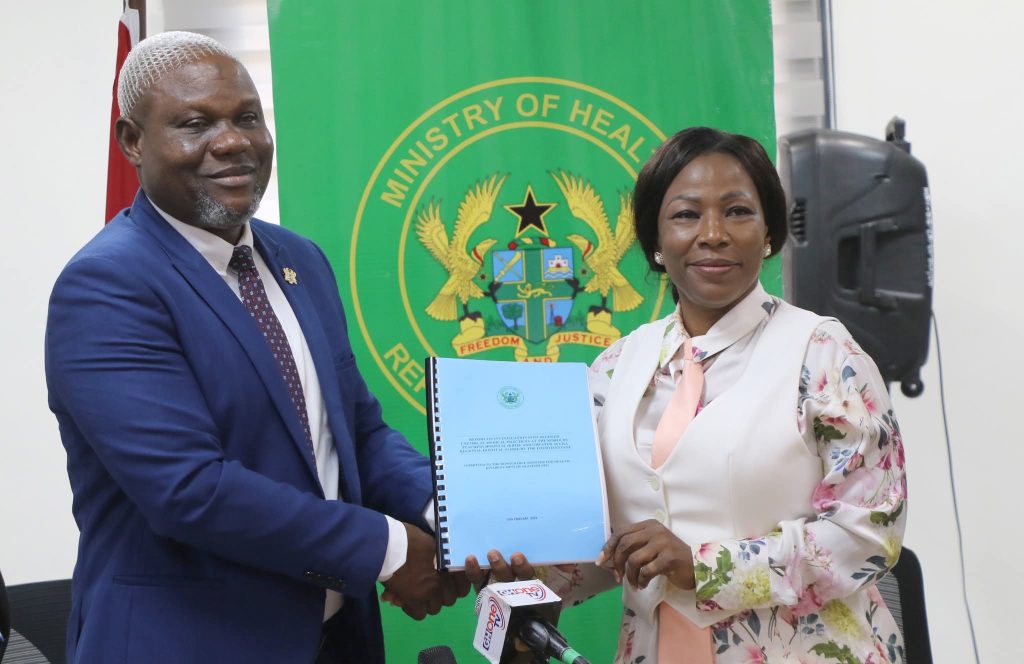
The Ministry of Health (Ghana) has officially received the investigative report into the alleged “medical kalabule” practices at the Korle Bu Teaching Hospital and the Greater Accra Regional Hospital, signaling a decisive step toward reinforcing accountability within the nation’s healthcare system.

The report was submitted on behalf of the Minister for Health, Kwabena Mintah Akandoh, to Deputy Minister Prof. Dr. Grace Ayensu-Danquah, who received the findings, underscoring the Ministry’s commitment to transparency and ethical governance in public health institutions.
According to the committee’s findings, a medical officer violated the Ghana Health Service Code of Conduct by directly accepting payments from a patient for a surgical item required for an amputation. Additionally, the report revealed that an improper payment in United States dollars had been made to a supplier, contravening regulations established by the Bank of Ghana.
The committee’s investigation went beyond individual misconduct to examine systemic challenges affecting the availability of neurosurgical implants and related consumables. Financial constraints at the Greater Accra Regional Hospital were identified as a key factor limiting the facility’s capacity to maintain adequate stocks of critical implants. In some cases, patients were required to procure necessary surgical items directly from private suppliers before undergoing procedures, raising concerns over transparency and access to essential care.
Despite public speculation, the committee found no evidence to substantiate claims of deliberate collusion, popularly referred to as “medical kalabule,” between medical personnel and suppliers.
To prevent future occurrences and strengthen governance within the health sector, the committee recommended a range of reforms. Key measures include enhancing hospital complaint management systems, introducing mandatory orientation programmes on legal and ethical standards for medical personnel, and ensuring accurate documentation and cataloguing of neurosurgical procedures and implants.
The report also suggested establishing a ring-fenced implant revolving fund to support the sustainable procurement of critical medical supplies and developing clear policies to regulate intramural medical practice in public hospitals.
Receiving the findings, Prof. Ayensu-Danquah commended the committee for its thorough and independent work, reiterating that the Ministry remains steadfast in upholding the highest standards of professionalism, transparency, and accountability. She assured the public that the Ministry would take decisive action based on the report’s recommendations.
The Ministry of Health further affirmed its commitment to strengthening governance, improving procurement processes, and enhancing accountability in all health facilities across the country, ensuring that patients continue to receive ethical, safe, and high-quality healthcare services.