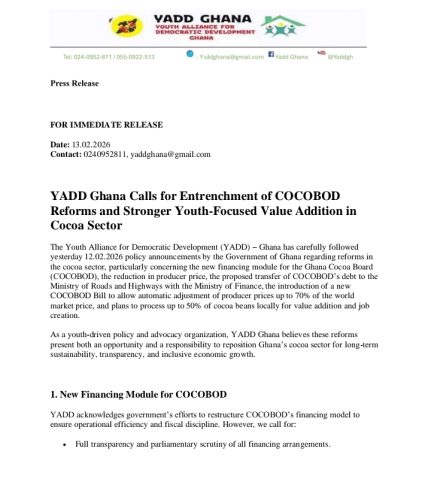
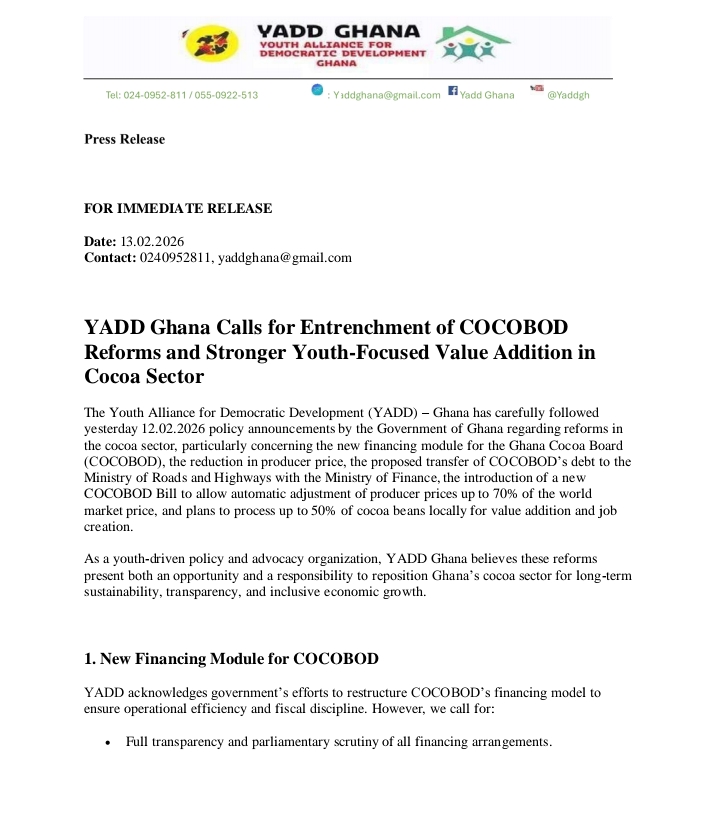
The Youth Alliance for Democratic Development (YADD) – Ghana has urged Parliament to entrench the new Ghana Cocoa Board (COCOBOD) Bill, calling for reforms that place farmers at the center of policy, empower youth through value addition, and secure the long-term sustainability of Ghana’s cocoa sector.
The call follows government policy announcements on 12 February 2026, which outlined a new financing model for COCOBOD, a reduction in producer prices, a proposed transfer of COCOBOD’s debt to the Ministry of Roads and Highways under the Ministry of Finance, and plans to locally process up to 50% of cocoa beans. The reforms also include a provision for automatic adjustment of producer prices up to 70% of the world market price.
Transparency and Accountability in COCOBOD Financing
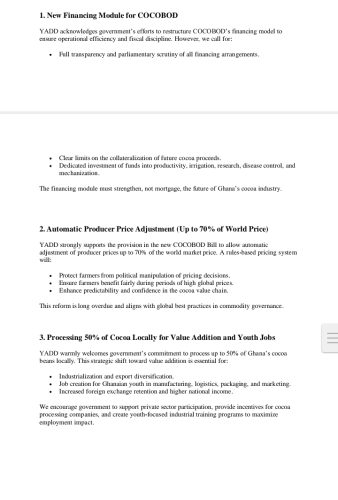
YADD commended government efforts to restructure COCOBOD’s financing to improve efficiency and fiscal discipline. However, the youth advocacy group emphasized the importance of full transparency and parliamentary oversight. The organization called for clear limits on the collateralization of future cocoa proceeds and for investments to prioritize productivity, irrigation, research, disease control, and mechanization.
“The financing module must strengthen, not mortgage, the future of Ghana’s cocoa industry,” the statement stressed.
Support for Rules-Based Producer Pricing
The organization strongly supported the new COCOBOD Bill’s provision for automatic producer price adjustments up to 70% of the world market rate. YADD stated that a rules-based pricing mechanism will protect farmers from political interference, ensure fair benefits during periods of high global prices, and provide predictability and confidence across the cocoa value chain.
“This reform is long overdue and aligns with global best practices in commodity governance,” the youth group added.
Local Cocoa Processing and Youth Employment
YADD welcomed the government’s commitment to locally process up to 50% of Ghana’s cocoa beans, describing it as a vital step toward industrialization, export diversification, and job creation for young Ghanaians. The organization urged government support for private sector participation, incentives for cocoa processing companies, and youth-focused industrial training programs to maximize employment in manufacturing, logistics, packaging, and marketing.
Entrenchment of the COCOBOD Bill
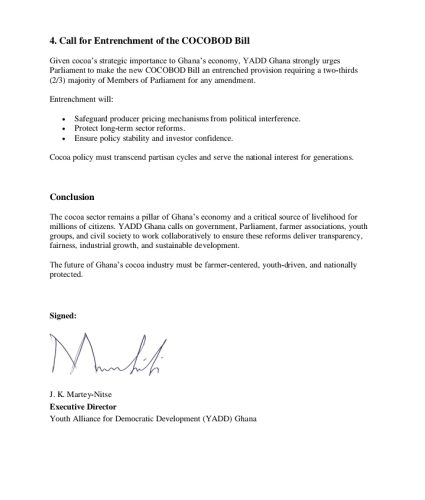
Given cocoa’s strategic importance to Ghana’s economy, YADD called on Parliament to entrench the new COCOBOD Bill, requiring a two-thirds majority for any amendments. The youth group stressed that entrenchment would safeguard producer pricing mechanisms from political manipulation, protect long-term sector reforms, and enhance policy stability and investor confidence.
“Cocoa policy must transcend partisan politics and serve the national interest for generations,” the statement affirmed.
Conclusion
YADD Ghana concluded by urging all stakeholders—including government, Parliament, farmer associations, youth groups, and civil society—to collaborate to ensure that these reforms deliver transparency, fairness, industrial growth, and sustainable development. The organization emphasized that Ghana’s cocoa industry must remain farmer-centered, youth-driven, and nationally protected.
Signed: Youth Alliance for Democratic Development (YADD) – Ghana