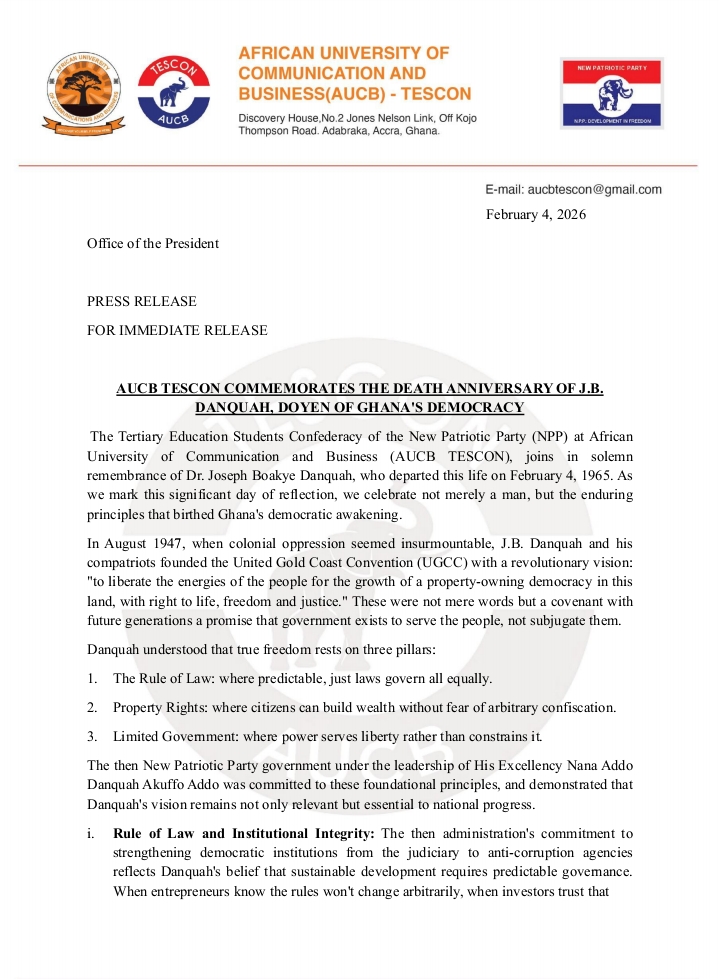
The Tertiary Education Students Confederacy of the New Patriotic Party (NPP) at the African University of Communication and Business (AUCB TESCON) has joined the nation in solemn remembrance of Dr. Joseph Boakye Danquah, who passed away on February 4, 1965. As this significant anniversary is observed, AUCB TESCON reflects not only on the life of a distinguished statesman but also on the enduring principles that laid the foundation for Ghana’s democratic awakening.
In August 1947, at a time when colonial domination appeared insurmountable, J.B. Danquah and his compatriots founded the United Gold Coast Convention (UGCC) with a revolutionary vision “to liberate the energies of the people for the growth of a property-owning democracy in this land, with the right to life, freedom, and justice.” This declaration was more than a political statement; it was a covenant with future generations, affirming that government exists to serve the people rather than subjugate them.
Dr. Danquah firmly believed that true freedom rests on the rule of law, the protection of property rights, and the principle of limited government. To him, a just society was one in which laws were predictable and applied equally, citizens could build and protect wealth without fear of arbitrary confiscation, and political power was exercised in service of liberty rather than as a tool of oppression.
The New Patriotic Party government under the leadership of His Excellency Nana Addo Dankwa Akufo-Addo demonstrated a strong commitment to these foundational ideals, proving that Danquah’s vision remains both relevant and indispensable to Ghana’s national development. Through efforts to strengthen democratic institutions, uphold judicial independence, and reinforce anti-corruption mechanisms, the administration reflected Danquah’s conviction that sustainable progress requires predictable and accountable governance. When citizens trust the justice system, investors believe contracts will be honoured, and entrepreneurs operate under stable rules, economic growth naturally follows.
In furtherance of economic freedom and property ownership, policies aimed at improving the ease of doing business, digitising public services, and formalising property rights echoed Danquah’s long-standing call for a property-owning democracy. By reducing bureaucratic barriers and curbing corruption, these reforms empowered Ghanaians to start businesses, save securely, and build generational wealth — precisely the society envisioned by Danquah in 1947.
The administration also recognised that liberating human potential requires removing barriers to opportunity. Initiatives such as Free Senior High School (Free SHS) and digital financial inclusion embodied Danquah’s principle of “liberating the energies of the people” in a modern context, ensuring that education and economic participation are accessible to all, regardless of background.
However, the legacy of J.B. Danquah also presents a challenge. AUCB TESCON acknowledges that significant work remains in combating corruption that undermines the rule of law, resisting factionalism that weakens party unity, strengthening civic education to help citizens translate freedom into daily life, and building resilient institutions capable of withstanding leadership transitions.
As the nation looks toward 2028, a critical question arises: Are we worthy inheritors of Danquah’s legacy? The NPP’s path to renewed electoral success does not lie in tribal calculations or short-term inducements, but in offering what Danquah promised — a society governed by clear rules, secure property rights, and constrained arbitrary power. This is not abstract philosophy; it is the practical difference between a hardworking trader who prospers and one who loses everything to the whims of authority.
As part of its commitment, AUCB TESCON pledges to educate students on the relevance of Danquah’s principles to contemporary challenges, advocate for policies that strengthen the rule of law and economic freedom, mobilise the youth around a vision of governance that serves rather than dominates, and challenge complacency whenever the party strays from its founding ideals.
J.B. Danquah died in detention, a martyr to the very freedom he championed. His sacrifice demands more than ceremonial remembrance; it calls for renewed dedication. As he urged Ghanaians to persevere when retreat seemed tempting, so must today’s generation persist in building the Ghana he envisioned — a nation where every citizen can live, work, and prosper in freedom under law.
The battlefields of education await. The work of nation-building continues. And the principles proclaimed in August 1947 remain Ghana’s surest guide.
Long live the memory of J.B. Danquah!
Long live the tradition of Dombo–Busia–Danquah!
Long live Ghana’s democracy!
Issued by:
Justice Kwasi Forson
Communication Director
AUCB TESCON Executive Committee