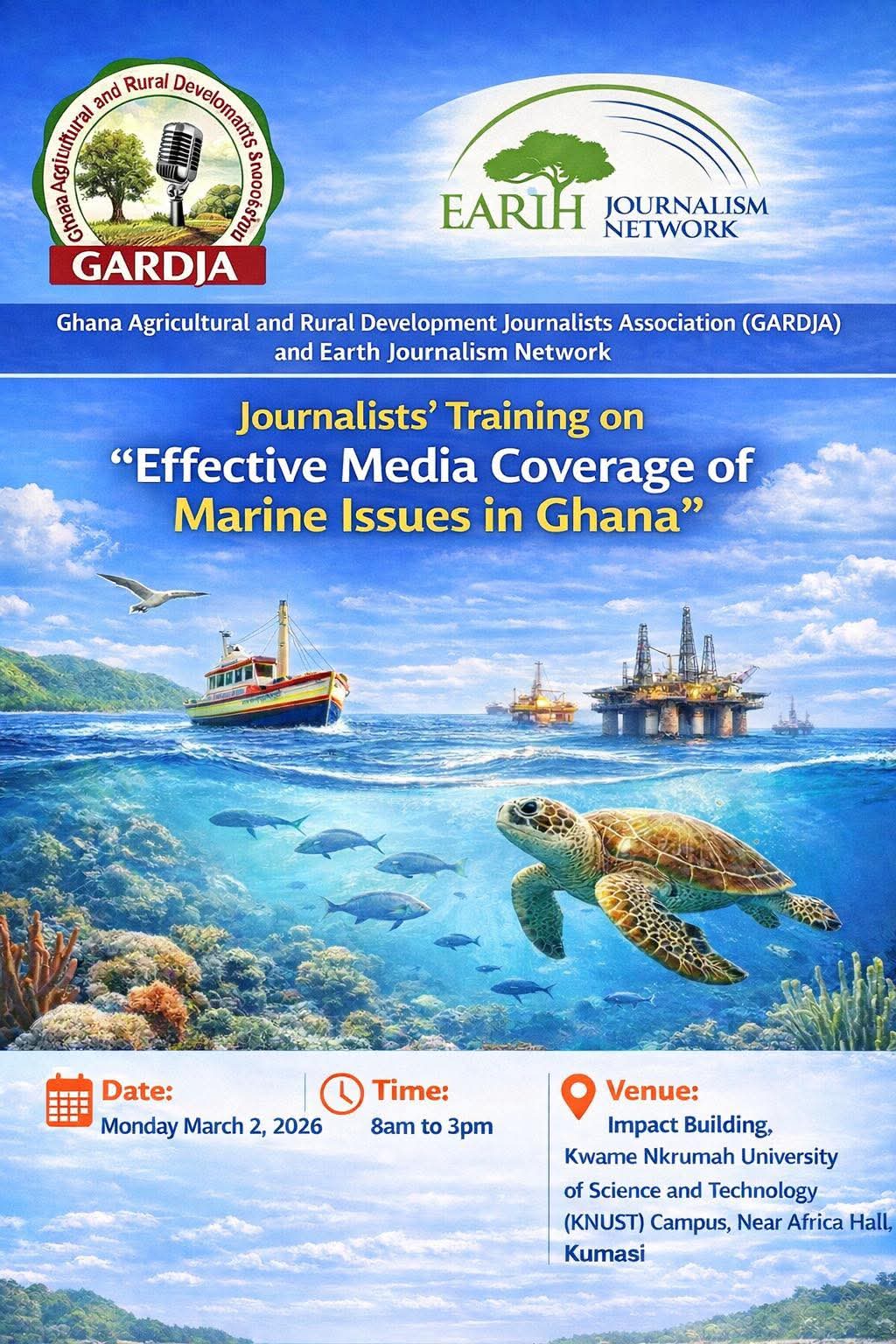
The Ghana Agriculture and Rural Development Journalists Association (GARDJA) has announced plans to train journalists across the country in marine conservation and environmental reporting as part of a nationwide initiative dubbed the “Save Our Sea (SOS) Campaign.”
The six-month journalism-led campaign, supported by the Earth Journalism Network, seeks to strengthen media advocacy against illegal fishing and promote sustainable management of Ghana’s marine resources. The initiative is expected to enhance public awareness, encourage policy accountability and contribute to the protection of marine biodiversity along Ghana’s coastline.
According to GARDJA, the SOS Campaign will focus on equipping selected journalists with in-depth knowledge and practical skills in marine ecology, fisheries regulations, investigative environmental reporting, environmental data analysis and safety at sea. The training is designed to empower media practitioners to produce impactful, evidence-based stories that highlight the environmental, economic and social consequences of illegal, unreported and unregulated (IUU) fishing.
The first in a series of specialized workshops is scheduled to take place on March 2, 2026, at the Kwame Nkrumah University of Science and Technology (KNUST) campus in Kumasi. The workshop will bring together selected journalists from various media houses to engage with experts in marine science, fisheries management and environmental governance.
Organizers say the campaign comes at a critical time when Ghana’s fisheries sector continues to face challenges including declining fish stocks, destructive fishing practices and threats to coastal livelihoods. By strengthening the capacity of journalists to investigate and report accurately on marine issues, GARDJA aims to amplify national conversations around sustainable fishing practices and biodiversity conservation.
The association emphasized that the role of the media is pivotal in shaping public discourse and influencing policy reforms. Through the SOS Campaign, journalists will be encouraged to undertake field reporting assignments, collaborate with marine scientists and leverage data-driven storytelling techniques to expose illegal activities and promote responsible stewardship of marine resources.
GARDJA further noted that the initiative aligns with broader global efforts to protect ocean ecosystems and achieve sustainable development, particularly in coastal communities that depend heavily on fishing for their livelihoods.
The “Save Our Sea” Campaign is expected to run for six months, with additional workshops and public engagement activities planned across different regions of the country. Organizers are optimistic that the initiative will foster a new generation of environmentally conscious journalists committed to safeguarding Ghana’s marine life and coastal ecosystems for future generations.